Belonging and inclusion are not the same thing. One is handed to a child. The other is earned, usually through something slightly ridiculous.
Mine involved a stranger’s television.
Part Three of “Lessons We Learned the Hard Way.” Read Part One — “The Two-Mile Cover-Up” and Part Two — “Meet Me Behind the Shed”.
Before Adults Ran Everything
Before organized sports took over every season, neighborhood kids organized themselves.
There were no registration fees, matching uniforms, certified officials, or adults standing nearby with water bottles and first-aid kits.
There was a ball, an open space, and an argument over who was on which team.
That was enough.
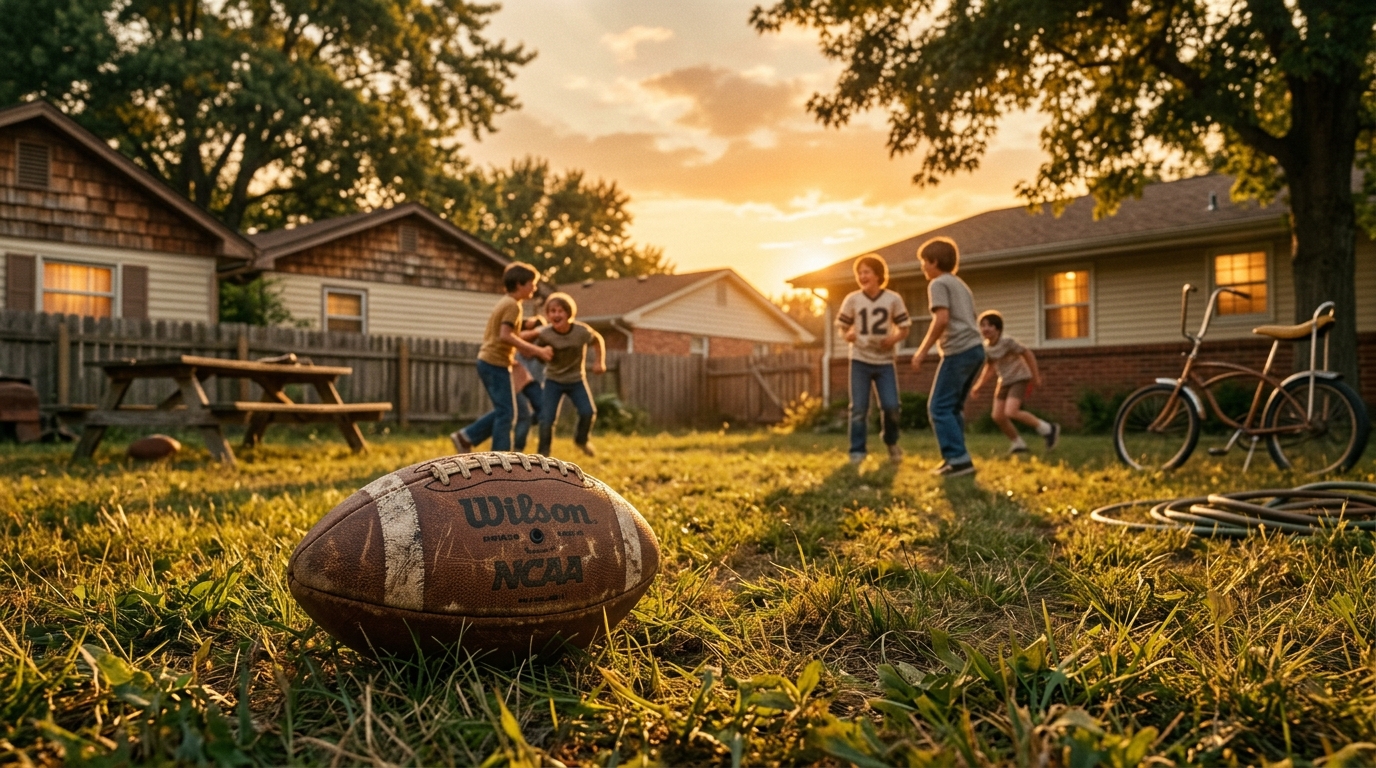
As the older kids in our neighborhood started moving on to middle school and high school, we had one final legendary summer of full-contact, no-pads backyard tackle football.
The games were intense.
There were hard hits, grass-stained jeans, disputed touchdowns, and just enough chaos to make every play feel like it was happening in the Super Bowl.
Nobody worried about participation time. If you wanted the ball, you had to convince the older kids that throwing it to you wasn’t a complete waste of a play.
Protected Is Not the Same as Accepted
Because I was younger and skinnier, most of the older guys looked out for me. But being protected wasn’t the same as being accepted. I didn’t want them to treat me like someone’s little brother.
I wanted to be part of the game.
More specifically, I wanted someone to throw me a deep pass.
One afternoon, Spark — the unofficial commissioner, quarterback, and director of neighborhood bad decisions — looked at me with that familiar mischievous glint in his eye.
“See that house over there?” he asked.
I looked across the yard and nodded.
“Run inside, turn off their TV, and sprint back. Do that, and I’ll throw you a bomb.”
There was no explanation.
I didn’t ask whether he knew the people inside. I didn’t question the legality or wisdom of entering a stranger’s home and interrupting their evening television.
I had been promised a deep pass.
That was all the information I needed.
The Evening News, Briefly Interrupted
I sprinted across the yard, burst through the door like a confused paperboy, and found two older people sitting in their living room watching the evening news.
They looked at me.
I looked at them.
Then I reached over, turned off their television, and ran out the door.
I didn’t say hello.
I didn’t explain that this was part of an advanced football-development program.
I simply turned off their TV and bolted from the house as though I had robbed a bank.

I raced back across the yard, breathless and wide-eyed.
Spark gave me a satisfied nod.
Then he tossed me the ball.
Mission accomplished.
That is officially how I earned my first deep pass in backyard tackle football.
Several Parts of This Are Hard to Defend
Looking back, several parts of this story are difficult to defend.
Entering someone’s house uninvited was not a good decision. Interrupting two innocent people’s evening news was not an act of courage. And Spark was probably not qualified to administer character-building exercises.
But childhood was filled with strange tests of belonging.
Every neighborhood had its leaders. The older kids decided the games, made the rules, settled the arguments, and determined whether the younger kids were ready to join them.
There were no certificates for being included. Nobody sat us down and said, “Congratulations — you are now a valued member of our neighborhood community.”
You simply kept showing up.
You carried equipment. You accepted the worst position. You got knocked down, got back up, and waited for your opportunity.
Sometimes you even turned off a stranger’s television.
The Pass Was Never About the Pass
I thought I was running into that house because I wanted Spark to throw me the football. But the pass represented something larger.
It meant I had earned a place in the huddle.
Children need that sense of belonging. They need to know they matter to a family, classroom, team, or neighborhood. But genuine belonging is different from automatic inclusion.
Belonging carries responsibility. It means contributing something, learning the group’s expectations, and proving that other people can depend on you.
It isn’t always comfortable, and it isn’t always fair. Sometimes the effort required to belong is what makes membership meaningful.
What Kids Lose When Adults Manage Everything
Today, adults often organize every part of childhood. We select the teams, supervise the games, settle the disagreements, schedule the activities, and make sure everyone receives an equal opportunity.
Some of that is good. Considering Spark’s preferred leadership methods, adult supervision might occasionally have been helpful.
But when adults manage everything, children lose opportunities to negotiate, take social risks, solve disagreements, and figure out where they fit.
Our neighborhood games weren’t always safe, fair, or sensible.
But they belonged to us.
We made the teams. We changed the rules. We argued over whether someone stepped out of bounds. We played until it became too dark to see the ball, and then we came back the next day and did it again.
The Part That Actually Stuck
Nobody handed me that deep pass.
I had to earn it.
Was running into a stranger’s house the best way to do that?
Absolutely not.
But when Spark finally dropped back and threw the ball in my direction, I wasn’t just the skinny younger kid anymore.
For one play, I belonged.
And sometimes that is all a kid is really asking for: a place in the huddle and a chance to see whether he can make the catch.
This week, try this: find one thing a young person in your life can genuinely contribute — not a job invented to make them feel included, but a real one the group would miss if it went undone. Then let them do it without stepping in to smooth the rough parts. Inclusion is something you can hand a child in a minute. Belonging is something they have to be allowed to earn.
If you missed how Spark earned his reputation in the first place, start with “Every Neighborhood Had a Spark”.
This story first appeared on Matt’s Substack. Read the original post — “How I Earned the Deep Pass” — and subscribe to the newsletter for short stories and practical lessons like this one every week.